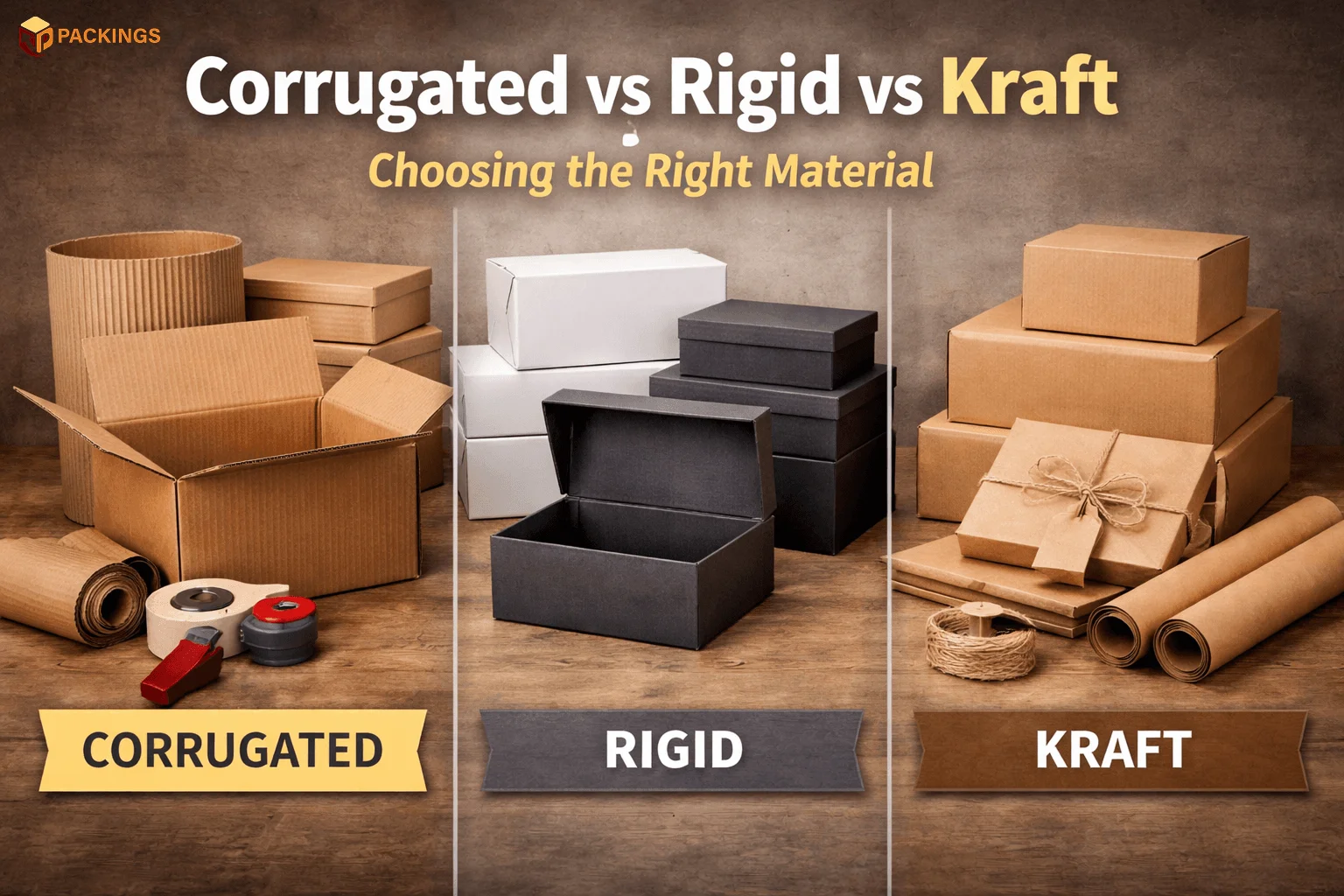
Corrugated vs Rigid vs Kraft: Choosing the Right Material
Picking the wrong packaging material is an expensive mistake. Not because the box itself costs too much, but because it either over-protects a product that didn't need it or under-delivers on the shelf presence your brand requires. A rigid two-piece box for a $6 bar of soap makes no financial sense. A thin folding carton for a $90 fragrance set makes no brand sense.
The three materials that dominate the custom packaging industry in the US right now are corrugated fiberboard, rigid chipboard, and kraft paperboard. Each one serves a different job. This guide breaks down where each material wins, where it falls short, and which product categories it fits best so you pick the right one on the first order, not the third.
What Is Corrugated Packaging?
Corrugated fiberboard is not cardboard. People use the words interchangeably, but they're structurally different. Corrugated board has a fluted medium, a wavy arched paper layer sandwiched between two flat linerboards. That fluted layer is what gives the material its crush resistance, shock absorption, and stacking strength while keeping the overall weight low.
The flute grade determines performance. B-flute (about 1/8 inch thick) is standard for mailer boxes and e-commerce packaging. E-flute (about 1/16 inch) is thinner, prints cleaner, and works well for retail-ready packaging and folding cartons with corrugated backing. C-flute sits in between and handles heavier loads, think appliance boxes and bulk shipping containers.
Most corrugated linerboard is made from kraft paper. So when someone says "kraft box" and means a brown corrugated mailer, they're technically using a kraft-lined corrugated box. The distinction matters when you're specifying material with a supplier, because "kraft" on its own usually refers to solid kraft paperboard, not corrugated.
Best Uses for Corrugated Boxes
Corrugated is the default for anything that ships. Subscription boxes, DTC e-commerce orders, food delivery, product kits, and anything fragile that needs to survive a UPS truck. It's the most recycled packaging material in the United States. The American Forest & Paper Association reports corrugated recovery rates consistently above 90 percent. That makes it a strong pick for brands building sustainability into their supply chain.
Cost wise, corrugated sits in the middle. A custom printed corrugated mailer runs $0.40 to $3.00 per unit depending on size, print coverage, and quantity. It accepts digital, flexo, and litho-laminated printing. The print quality on E-flute rivals folding cartons when litho-laminated, which is why so many DTC brands use it as both the shipping container and the brand experience in one box.
What Is Rigid Packaging?
Rigid boxes, also called setup boxes, are made from thick chipboard (greyboard), typically ranging from 800gsm to 1500gsm. The board gets wrapped in printed paper, specialty fabric, or coated stock. Unlike corrugated and folding cartons, rigid boxes arrive pre-assembled. No folding, no tab-locking. They hold their shape permanently.
That structural permanence is the entire point. When a customer lifts the lid off a rigid box, the weight and solidity of the material communicate value before the product is even visible. It's why Apple packages phones in rigid boxes. It's why high-end spirits, perfume, jewelry, and cosmetics brands default to rigid. The box is part of the product experience.
Best Uses for Rigid Boxes
Rigid is the move when your packaging needs to justify a premium price point, create a memorable unboxing moment, or sit on a retail shelf as a display piece. Think luxury cosmetics, artisan chocolates, jewelry, limited-edition product drops, corporate gift sets, and PR mailer kits sent to influencers.
The tradeoff is cost. Rigid boxes run $3.00 to $12.00+ per unit at wholesale volumes. They're heavier to ship. They can't be flat-packed unless you're using collapsible rigid, which adds its own cost. And they often require hand assembly for components like magnetic closures, ribbon pulls, or custom foam inserts. But for products where the packaging is a brand asset, not a disposable wrapper, rigid earns its price back through perceived value, social sharing, and repeat purchases.
One important production note: rigid boxes need an outer corrugated shipper for transit. You don't ship a rigid box naked through the mail. It's a box-in-a-box setup. The rigid inner box handles presentation. A corrugated outer box handles protection.
What Is Kraft Packaging?
Kraft paper gets its name from the German word for strength. It's produced through the kraft chemical pulping process, which breaks down wood into long, strong cellulose fibers. The result is a coarse, fibrous paper with high tensile strength in its natural unbleached brown color. It can also be bleached white, though the brown version dominates in packaging because of its association with natural, eco-conscious branding.
Kraft paperboard, the thicker board-form version, is used for folding cartons, tuck-end boxes, sleeve packaging, and lightweight retail packaging. It's not corrugated (no fluted layer) and it's not rigid (no chipboard core). It occupies the middle ground: lighter than corrugated, more affordable than rigid, and strong enough for products that don't need heavy-duty protection during shipping.
Best Uses for Kraft Boxes
Kraft is trending hard in 2026 across DTC brands, soap makers, candle companies, coffee roasters, bakeries, and artisan food brands. The natural brown surface with a clean one or two-color print reads as authentic and environmentally responsible. It pairs well with soy-based inks and water-based coatings, which reinforces the eco-friendly positioning.
Cost per unit on kraft paperboard boxes runs $0.35 to $2.50 depending on size, board thickness (commonly 300gsm to 350gsm for packaging), and print method. It takes digital and offset printing well. Finishes like matte lamination, debossing, and foil stamping work on kraft, though spot UV and gloss lamination tend to look better on white SBS stock because of the contrast.
The limitation is protection. Kraft paperboard alone doesn't offer the crush resistance of corrugated or the rigidity of chipboard. If your product ships direct to consumer, a kraft box usually needs to go inside a corrugated mailer or shipping box for transit safety. For retail shelf packaging where the product goes from your warehouse into a store display, kraft on its own works fine.
Packaging Material Comparison: Corrugated vs Rigid vs Kraft
Here's how the three stack up across the factors that matter most when choosing a material for your custom boxes:
|
Factor |
Corrugated |
Rigid |
Kraft |
|
Protection |
High. Fluted cushioning absorbs impact |
Medium. Solid but needs outer shipper |
Low to medium. No fluted layer |
|
Brand Presence |
Medium. Litho-lam improves it |
Very high. Premium unboxing feel |
High for eco and artisan brands |
|
Cost Per Unit |
$0.40 to $3.00 |
$3.00 to $12.00+ |
$0.35 to $2.50 |
|
Print Quality |
Good on E-flute, great with litho-lam |
Excellent. Wrapped printed stock |
Good, especially with digital |
|
Sustainability |
90%+ recycling rate, biodegradable |
Recyclable if components are separable |
Highly recyclable, biodegradable, compostable |
|
Weight |
Light |
Heavy |
Very light |
|
Assembly |
Flat-packed, user-assembled |
Pre-assembled or collapsible |
Flat-packed, user-assembled |
|
Best For |
Shipping, e-commerce, subscriptions |
Luxury, gifting, premium retail |
Artisan, eco brands, bakery, retail |
How to Choose the Right Material for Your Product
Forget about picking the "best" material in the abstract. The right material is the one that matches three things: your product's protection requirements, your brand's positioning, and your budget at the order volume you need.
If your product ships directly to the customer's door, corrugated is almost always the answer. It protects, it brands, and it does both in a single box. Most e-commerce brands, subscription companies, and food delivery businesses land here.
If your product sits on a retail shelf or goes inside a gift bag kraft paperboard gives you clean branding at a low cost. It works for soap, candles, bakery items, tea, coffee, cosmetics, and anything positioned as natural or artisan.
If your product is premium and the packaging is part of the value rigid is worth the investment. Perfume, jewelry, electronics, luxury cosmetics, spirits, and limited-edition drops all benefit from the weight and structure that only chipboard delivers.
If you need both protection and presentation, use the box-in-a-box approach. A kraft or rigid inner box for the brand experience, and a corrugated outer shipper for transit. This is standard practice across luxury e-commerce.
Which Packaging Materials Does Packings.co Offer?
All three. We manufacture custom boxes in corrugated, rigid, and kraft, plus cardboard, display, and specialty structures. Every order includes free shipping across the USA, no plate or die charges, and minimum orders starting at 100 units.
Not sure which material fits your product? Our packaging team has handled orders across cosmetics, food, CBD, candles, apparel, soap, and gift packaging. Tell us what you're packing and we'll recommend the right material, board weight, and finish before you commit to a quote.
Request a free quote at packings.co. We'll respond within 24 hours with material recommendations, pricing, and a digital proof. No minimum pressure, no obligation.
FAQs: Corrugated vs Rigid vs Kraft
Q: Is corrugated the same as cardboard?
No. Corrugated has a fluted wavy layer between two flat linerboards that provides cushioning and crush resistance. Cardboard is a single layer paperboard with no internal structure. They look similar but perform very differently.
Q: Which box material costs the least per unit?
Kraft paperboard starts at $0.35 per unit. Corrugated starts around $0.40. Rigid chipboard starts at $3.00 and goes up from there because of thicker board and hand assembly.
Q: Does kraft accept full color printing?
Yes, but the brown surface shifts how colors look. Dark inks and white ink on brown kraft look sharp. For vibrant full bleed color, white SBS or litho-laminated corrugated gives a cleaner result.
Q: What makes kraft packaging sustainable?
Unbleached kraft is recyclable, biodegradable, and compostable. It uses fewer chemicals than bleached alternatives. Pair it with soy-based inks and water-based coatings for one of the greenest packaging setups available.
Q: Can I ship rigid boxes without an outer box?
Not recommended. Rigid boxes are built for presentation, not transit. They need a corrugated outer shipper with void fill to arrive undamaged. Every luxury e-commerce brand uses this box-in-a-box method.
Q: What does flute grade mean in corrugated?
Flute grade refers to the thickness of the wavy inner layer. E-flute is thinnest and prints cleanest. B-flute is the standard for mailers. C-flute is thickest and handles heavy loads.
Q: What material do subscription box brands use?
Almost all use corrugated, usually B-flute or E-flute. It ships safely, prints in full color, and flat packs for storage. One box handles both shipping and branding.
Q: Can I combine different materials in one package?
Yes. A rigid inner box with a corrugated outer shipper is common. So is a kraft sleeve over a corrugated tray. Your supplier can recommend the best combination for your product.