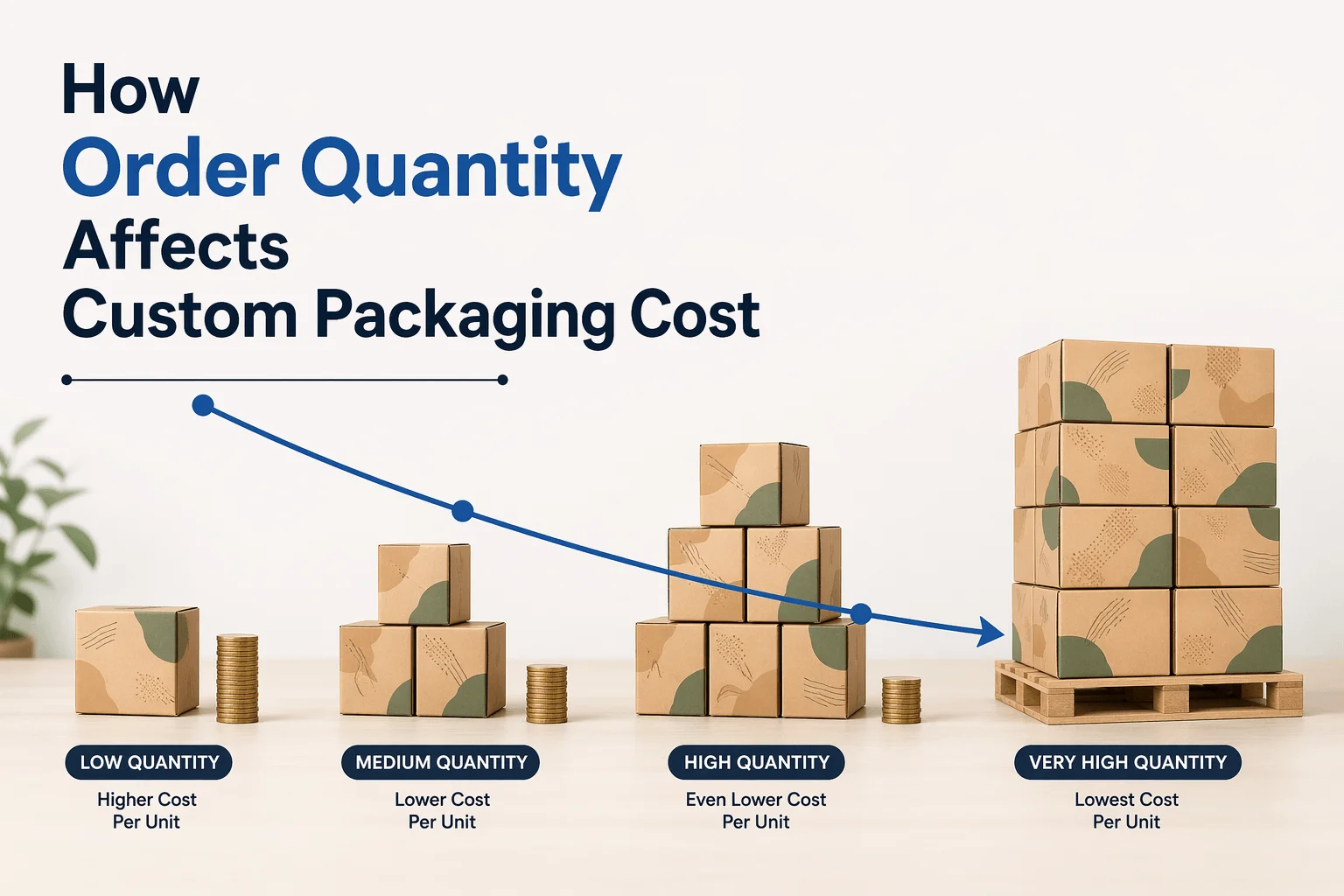
The same box, same material, same print, same finish can cost $4.50 per unit or $1.20 per unit depending on how many you order. That is not a pricing trick. It is how packaging manufacturing actually works, and roughly 4 out of 10 first-time buyers we work with order either too few (paying a steep premium per box) or too many (sitting on inventory they cannot use within the year).
According to the U.S. Bureau of Labor Statistics manufacturing data, fixed production costs in the paper and packaging sector, including machine setup, plate creation, and die cutting, remain constant regardless of whether the run produces 200 boxes or 20,000. Those costs have to land somewhere. On a short run, they land hard on every single unit.
Understanding where the price breaks happen, where they flatten out, and where over-ordering starts burning cash instead of saving it is one of the most important unit economics decisions a brand makes when sourcing custom corrugated boxes or any other wholesale packaging type.
Fixed Costs vs Variable Costs in Packaging
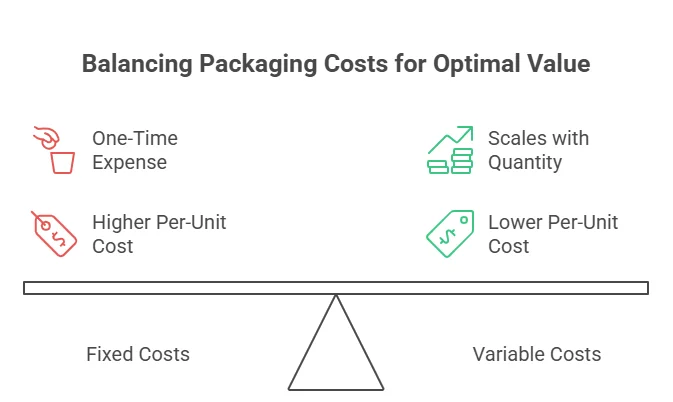
Every custom box order carries two types of production expenses, and they behave completely differently as quantity changes.
Fixed costs hit once and stay the same no matter the volume. Die cutting tooling, printing plate creation for offset runs, machine calibration, digital proof generation, dieline approval, and artwork setup all fall here. A die that costs $300 to produce costs $300 whether it stamps 100 boxes or 10,000. On a 100-unit run, that die adds $3.00 per box. On a 5,000-unit run, it adds $0.06. The setup fee does not shrink. It just gets divided across more units.
Variable costs scale with quantity but get cheaper per unit as volume rises. Raw materials like kraft paperboard, corrugated fiberboard in E-flute or B-flute configurations, and rigid chipboard are purchased in bulk at wholesale rates. Larger orders let the manufacturer buy full press sheets instead of cutting into partial stock, reducing material waste by 15 to 25 percent on a typical run. Printing presses run more efficiently on longer jobs because ink calibration, feeder alignment, and registration adjustment happen once during setup, then the machine produces continuously. Lamination, foil stamping, embossing, spot UV, and other finishing processes follow the same efficiency curve.
Where the Per-Unit Price Breaks Actually Land
Not every quantity jump saves the same amount. The sharpest cost reductions happen early, then diminishing returns take over. Here is what we consistently see across custom cardboard box orders in 2026:
|
Order Quantity |
Typical Per-Unit Cost |
What This Tier Is For |
|
100 to 250 units |
$3.50 to $5.00 |
Product testing, sample runs, design validation |
|
500 units |
$1.80 to $2.50 |
First real savings tier, 3-month inventory for most brands |
|
1,000 to 2,000 units |
$1.00 to $1.80 |
Core scaling range for DTC, e-commerce, and retail |
|
3,000 to 5,000 units |
10 to 15% below 2K pricing |
Diminishing returns, only justified by fast sell-through |
The jump from 100 to 500 units is where the math changes the most. Fixed setup costs get spread five times wider, which alone can cut the per-unit price by 30 to 40 percent. After 2,000 units, production efficiency is already optimized, material waste is already minimized, and each additional box saves fractions of a cent. Chasing the absolute lowest unit price past this point only makes sense if the product consistently moves 500 or more units per month.
When Ordering More Actually Costs More
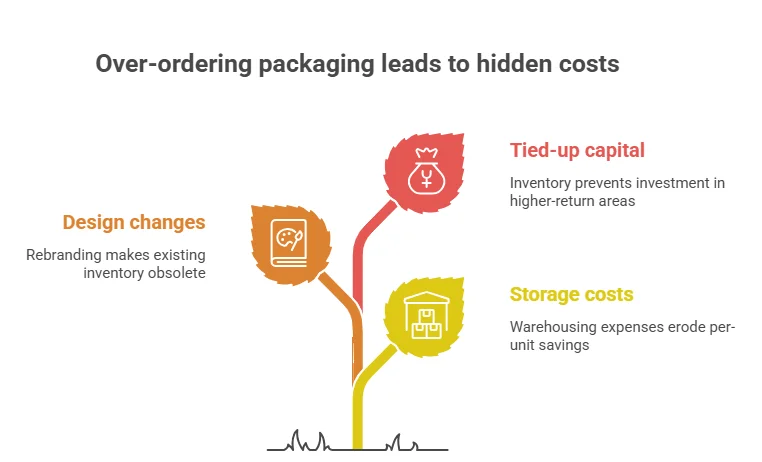
This is the part most packaging pricing guides skip entirely, and it is where we see brands make their most expensive mistakes. About 1 in 5 clients who order above 2,000 units on a first run end up with inventory they cannot use within 12 months. The per-unit savings they chased get wiped out by three hidden costs.
Storage and warehousing:
Accumulate month after month. A pallet of 2,000 rigid gift boxes takes up significantly more warehouse space than folding cartons because rigid boxes ship fully assembled. At typical warehouse rates of $0.06 to $0.12 per unit per month, eight months of storage on a 3,000-unit order adds $1,440 to $2,880 that never appeared on the packaging quote.
Design and branding changes:
Turn remaining inventory into waste overnight. A rebrand, a new product dimension, an updated logo, a regulatory label update. We watched one client discard 1,500 perfectly printed cosmetic boxes seven months after ordering 3,000 because they updated their tagline for a retail partnership. The bulk savings from that order disappeared completely.
Cash tied up in packaging:
Cannot work anywhere else. A 5,000-unit order at $1.10 per box locks $5,500 into inventory. For a growing brand, that capital invested in marketing or product development might generate far higher returns than a few cents saved per box.
How Material and Finish Choices Shift the Equation
Quantity is the biggest cost lever, but box complexity determines how steep the volume curve actually is.
Simple structures absorb low volumes well. A standard tuck end box in SBS cardstock with single-side digital print and basic matte lamination carries minimal fixed costs. The per-unit penalty for ordering 250 instead of 1,000 is moderate because there are no plate fees, no complex die charges, and print proofing is straightforward.
Premium structures amplify the volume effect dramatically. A magnetic closure rigid box with soft-touch lamination, gold foil stamping, embossed logo, and a custom foam insert stacks up steep fixed costs across die creation, foil plates, embossing tooling, and insert molding. On a 200-unit run, those setup expenses push the per-unit price to $6 or $7. At 1,000 units, the same box drops to $3.50. The more complex the packaging, the more heavily quantity drives the final unit cost.
Digital printing eliminates plate costs entirely, which lowers the entry point for short runs and makes orders under 500 units far more viable. Offset lithography wins above 1,000 units because the per-impression cost drops sharply once the press is calibrated. The packaging lead time is similar for both methods, typically 7 to 14 business days after proof approval.
Choosing the Right Order Quantity for Your Brand
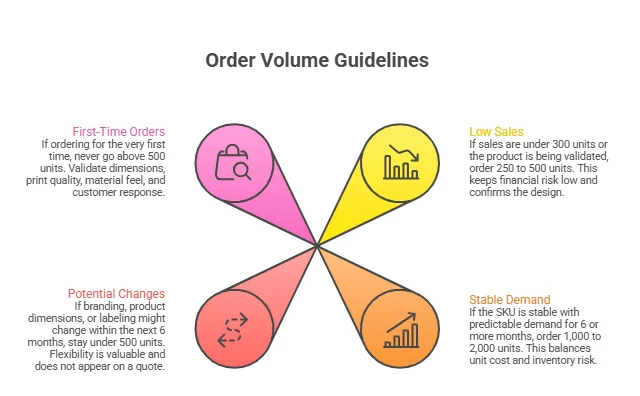
Skip the guesswork. Match order volume to where the business actually is right now:
If monthly sales are under 300 units or the product is still being validated, order 250 to 500. Keep the financial risk low, confirm the design works in the real world, and preserve cash for growth.
If the SKU is stable with 6 or more months of predictable demand, order 1,000 to 2,000. This is where unit economics hit their best balance between per-unit cost and inventory risk.
If branding, product dimensions, or labeling might change within the next 6 months, stay under 500 regardless of how attractive the 2,000-unit price looks. Flexibility has a value that does not show up on a quote sheet.
If ordering for the very first time, never go above 500. Validate dimensions, print quality, material feel, and customer response. Scale on the reorder, not the first run. That second order is where bulk pricing gets captured safely.
Always request pricing at three to four quantity tiers on a single quote. Seeing the cost at 250, 500, 1,000, and 2,500 side by side makes the breakpoints obvious and turns a gut feeling into a data-driven decision.
Get a tiered quote showing exact cost drops at 250, 500, and 1,000 units so you do not over-order or overpay on your first run. No plate fees, no die charges, free shipping across the USA. MOQ starts at 100 units on all custom packaging boxes.
Custom Packaging Cost by Order Quantity: Top Questions
What is MOQ in custom packaging?
MOQ (minimum order quantity) is the lowest number of units a supplier will produce in one run. It exists because fixed costs like dies, plates, and machine setup must be recovered regardless of volume. At Packings.co, MOQ starts at 100 units.
Where does the biggest price drop happen?
Between 100 and 500 units. Fixed costs spread across five times more boxes, cutting per-unit price by 30 to 40 percent. After 2,000 units, each additional box saves only a few cents.
Can bulk ordering actually lose me money?
Yes. Storage costs at $0.06 to $0.12 per unit per month, design changes that make leftover boxes unusable, and cash locked in inventory all erode per-unit savings. Order for 3 to 6 months of sales, not the lowest possible unit price.
Does box complexity change how much quantity matters?
Dramatically. Simple tuck end boxes carry low setup costs, so the volume penalty at 250 units is mild. Complex rigid boxes with foil, embossing, and inserts carry steep fixed costs that make the per-unit jump from 200 to 1,000 units far more significant.
How many units should I order the first time?
250 to 500. Validate the design, confirm product fit, and check print quality before committing more. Scale on the second order once everything is confirmed and customer feedback is in.
How do I compare quotes across packaging suppliers?
Request pricing at 3 to 4 quantity tiers on the same box spec from each supplier. Check what is included in the unit price. Some charge separately for plates, dies, proofs, and shipping. At Packings.co, all of those are included at zero extra cost.