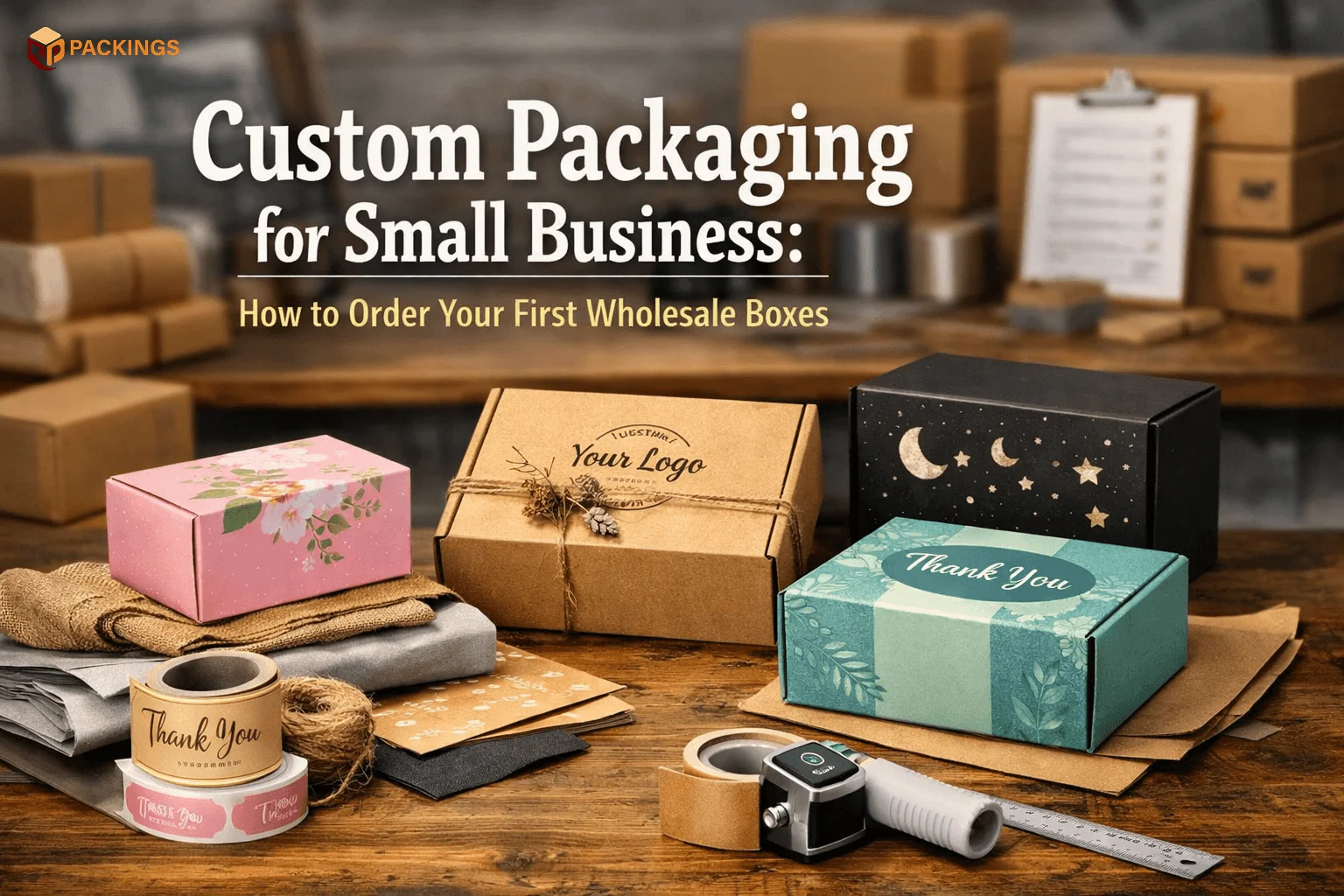
You've got a product that works. Customers like it. Sales are growing. But every order ships in a plain brown box with no branding, no personality, and no reason for the customer to remember your name once the tape comes off. That's where most small businesses sit right now. They know custom packaging would make a difference but the process feels complicated, expensive, or designed for brands ordering 10,000 units at a time.
It doesn't have to be that way. According to the U.S. Small Business Administration, there are over 33 million small businesses operating in the United States. Most of them sell physical products that ship in generic packaging. The brands that invest in custom printed boxes, even at low volumes, consistently outperform on customer retention, social sharing, and perceived product value.
This guide walks you through the entire process from choosing a box style to receiving your first order, written specifically for small businesses that have never ordered custom packaging before.
How to Choose the Right Box Style
The box style depends on what you're packing and how it reaches the customer.
Mailer boxes are the most popular choice for e-commerce and DTC brands. They're corrugated, ship flat, fold together without glue, and work as both the shipping container and the branded unboxing experience. Candle companies, subscription brands, soap makers, and skincare lines use them constantly.
Tuck end boxes are lightweight folding cartons made from cardboard or SBS paperboard. They work for retail shelf display. Think cosmetics, supplements, tea, coffee, and small food items. They're compact, print beautifully, and cost less per unit than mailers.
Rigid boxes are the premium option. Pre-assembled, thick, heavy in the hand. Jewelry brands, luxury cosmetics, high-end gifting, and limited-edition product drops use rigid. They cost more but they communicate value before the lid comes off.
Shipping boxes are standard corrugated containers for products that need maximum transit protection. Electronics, glass, heavy items, and multi-item orders. They're functional first, branded second.
If your product ships direct to the customer and needs to look good on arrival, start with a mailer. If it sits on a retail shelf, go with a tuck end. If the packaging is part of the luxury experience, rigid is worth the investment.
How to Pick the Right Material
Three materials cover 90 percent of small business packaging needs.
Corrugated fiberboard for anything that ships. The fluted inner layer absorbs impact and protects the product. Available in E-flute for lighter items and cleaner print, or B-flute for heavier products and better cushioning.
Kraft paperboard for eco-conscious and artisan brands. The natural brown surface with a clean one or two-color print signals authenticity. Coffee roasters, bakeries, soap brands, and handmade goods companies gravitate here because it's affordable and recyclable.
SBS (solid bleached sulfate) cardboard for retail packaging where color vibrancy matters. The white coated surface makes CMYK printing pop. Cosmetics, supplements, and food brands that need full bleed color on shelf use SBS.
Don't overthink material selection on your first order. If you ship to customers, pick corrugated. If you sell at markets or in stores, pick kraft or SBS. You can always refine on your second order once you see how customers respond.
What Finishes Should You Start With?
Finishes add cost per unit, so be selective on your first run. One well-chosen finish creates more impact than stacking four.
Matte lamination gives a smooth, non-reflective surface that feels premium. Works on every material. Adds $0.05 to $0.15 per unit. This is the safest first finish for any brand.
Foil stamping on your logo creates a metallic accent that catches light. Gold, silver, or rose gold. Adds $0.15 to $0.40 per unit. Strong for cosmetics, jewelry, and gift packaging.
Spot UV applies a glossy raised coating to specific areas, usually the logo or a design element. Creates contrast on matte surfaces. Adds $0.10 to $0.20 per unit.
Window patching adds a clear PET film panel so customers can see the product inside. Popular for bakery boxes, soap, candles, and food packaging. Adds $0.10 to $0.25 per unit.
For your first order, matte lamination alone gets you 80 percent of the premium effect at a fraction of the cost. Add foil or spot UV on your second order once you've confirmed the base design works.
How Many Boxes Should You Order First?
This is where most first-time buyers either overspend or under-order. The right starting quantity depends on your monthly sales velocity.
100 to 250 units if you're testing a new product or selling fewer than 50 units per month. This keeps your cash outlay low and lets you refine the design before committing to a larger run.
500 units if you have a proven product with consistent monthly sales. This is the sweet spot where per-unit cost drops meaningfully without tying up too much capital in packaging inventory.
1,000+ units once your product is established and you can forecast 3 to 6 months of demand. The per-unit cost at this volume is typically 40 to 50 percent lower than a 250 unit run.
A common mistake is ordering 2,000 boxes on a first run before validating the design. If something needs changing, whether it's a color shift, a sizing issue, or a branding update, you're stuck with inventory you can't use. Start small, confirm everything works, then scale.
What the Ordering Process Looks Like
The process is simpler than most small business owners expect.
Step 1. Choose your box style, dimensions, material, and finish. If you're not sure, your supplier can recommend based on your product.
Step 2. Submit your artwork or work with the supplier's design team to create it.
Step 3. Receive a digital proof showing exactly how your box will look when printed. Review colors, logo placement, text, and layout. Request revisions if needed.
Step 4. Approve the proof. Production begins. Standard turnaround runs 7 to 14 business days.
Step 5. Boxes ship to your door. At Packings.co, shipping is free across the entire USA on every order.
That's it. No factory visits, no complex procurement process, no six-figure purchase orders. Five steps from concept to delivered boxes.
Start Your Custom Packaging Today
Custom packaging isn't reserved for big brands with big budgets. If you sell a physical product, even 100 branded boxes can change how customers perceive your brand, how often they come back, and whether they share your product online.
Get the packaging that fits your brand and budget. Request a free, no-obligation quote today. We'll respond within 24 hours with recommendations on box style, material, finish, and pricing based on your product and order volume.
FAQs
Q: How much does custom packaging cost for a small business?
Most small business orders fall between $1.00 and $5.00 per box depending on material, size, print, and quantity. Ordering 500+ units brings the cost down significantly. At Packings.co there are no plate fees, die charges, or shipping costs added on top.
Q: What is the minimum order for custom boxes?
It varies by supplier. Some require 500 or 1,000 minimum. At Packings.co the minimum starts at 100 units, which makes it practical for new brands, product launches, and test runs.
Q: How long does it take to receive custom packaging?
Standard production takes 7 to 14 business days after proof approval. Rush orders can be completed in 4 to 6 business days with an additional surcharge.
Q: Do I need a designer to order custom boxes?
No. Many suppliers including Packings.co offer free design support. Send your logo and brand colors, and the design team will handle artwork setup, layout, and a digital proof for your approval.
Q: What file format do I need for my logo?
Vector files in AI, EPS, or PDF format are ideal. If you only have a PNG or JPG, your supplier can usually work with it, but vector ensures the sharpest print quality at any box size.
Q: Should I order a sample before a full run?
Yes. Always request a physical or digital sample before committing to a large order. It lets you check material quality, color accuracy, and structural fit with your product before spending on a full production run.